
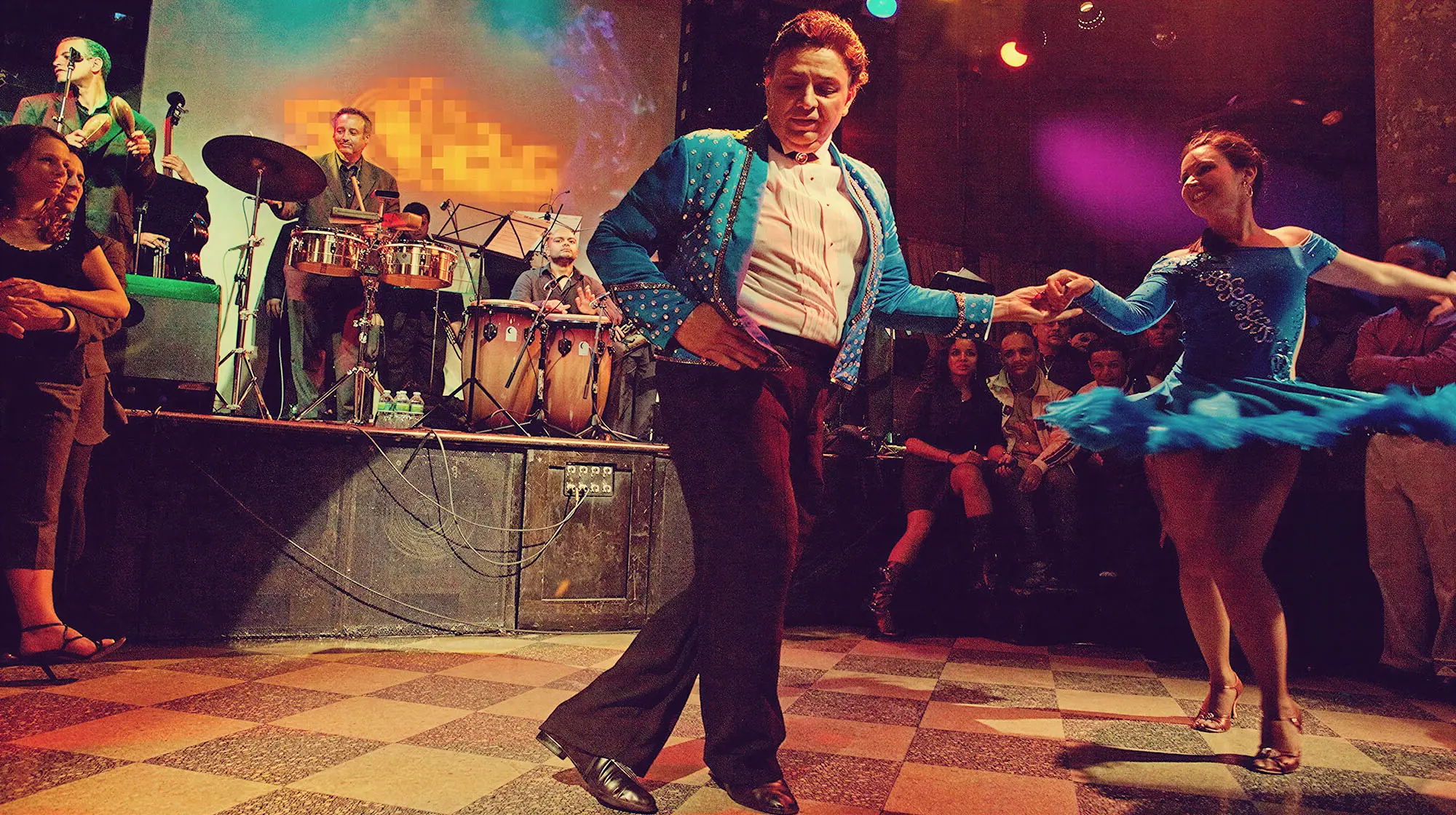
What is New York Style salsa?
New York Style salsa is a style of salsa usually danced “On2,” meaning the dancers take their break step on the second beat of the measure rather than the first beat, as in On1 salsa. Like On1 salsa, it is normally danced in a slot or line, rather than in the more circular style of Cuban or Colombian salsa.
How New York Style salsa developed
New York Style salsa developed out of Palladium-era mambo in New York’s Puerto Rican and Nuyorican communities (“Nuyorican” refers to Puerto Ricans living in or around New York). The style grew from Cuban son and mambo, while also absorbing influences from jazz, swing and tap. Later, Latin hustle influenced some of its longer turn patterns and its linear, slot-based movement.
Eddie Torres, featured in the video above, became the best-known teacher and popularizer of New York Style salsa. He did not invent dancing On2, but he helped organize its movements and timing into a teachable method, then spread the style through his classes, dance company and instructional videos.
On2 salsa is also often called mambo. The terms overlap, although mambo describes an older musical and dance tradition that existed before salsa. You can read more about that background in our history of salsa dancing.
What does New York Style salsa look like?
New York Style salsa is known for smooth weight changes, intricate turn patterns and detailed footwork. Partnerwork commonly uses the cross-body lead, in which one partner opens the slot and guides the other from one side to the other.
The style also places a strong emphasis on shines: sections where the partners separate and dance solo footwork before reconnecting. Shines can include syncopated steps, body movement, spins and musical accents, giving each dancer space to interpret the music individually.
New York Style is often described as smoother and more footwork-focused than LA Style salsa, which is commonly presented with sharper lines and flashier tricks. These are general tendencies rather than strict rules, and individual dancers may combine elements of both.
Is New York Style the same as salsa On2?
The terms are often used interchangeably, but they are not exactly the same. On2 describes the timing: the dancer changes direction on beats 2 and 6. New York Style describes a broader dance tradition that includes this timing along with linear partnerwork, shines, body movement and its New York history.
Not every dancer who breaks On2 uses the classic New York look, and the word mambo may also refer to related ways of dancing on the same timing. In everyday salsa conversation, however, “New York Style,” “On2” and “mambo” often overlap.
Salsa On2 timing
There are several ways to time the steps when dancing On2, but they all place the break step—the step that changes the dancer’s direction—on beats 2 and 6. The break step is not necessarily the first step taken in the measure.
Eddie Torres On2
The most common New York timing follows the standard salsa count of 1-2-3, 5-6-7, with pauses on 4 and 8. The dancer first steps on 1 and 5, then changes direction on 2 and 6. This is usually called Eddie Torres On2, or ET2.
ET2 is sometimes described as “ballroom 2,” but that label can be confusing. Ballroom mambo generally steps on 2-3-4 and 6-7-8, while ET2 steps on 1-2-3 and 5-6-7. Both break on 2 and 6, but they begin the pattern on different beats.
Power 2
An alternate timing is called Power 2, popularized by the Razz M’Tazz dance school in New York. Power 2 is counted 2-3-4, 6-7-8, with pauses on 1 and 5. The break step still occurs on 2 and 6, but the sequence starts one beat later than ET2. This timing comes from Palladium-era mambo and is closer to the timing of Cuban son.
Dancing with the clave
Some dancers also follow the clave, particularly during shines or when the clave is easy to hear. This approach is less standardized than ET2 or Power 2. Rather than following one fixed basic-step sequence, the dancer phrases movements around a 2-3 or 3-2 clave pattern.
How On2 connects with salsa music
Many dancers enjoy On2 because its break steps connect naturally with rhythmic cues in salsa music. The open slap of the conga commonly lands on beats 2 and 6 in the tumbao, giving dancers a clear sound to follow. Teachers may also use the clave, bass line or piano pattern to help students hear where the movement sits in the music.
New York Style dancers have traditionally favored salsa dura, including the hard-driving sound associated with classic New York salsa of the 1960s and 1970s. That is a preference rather than a rule: On2 can also be danced to slower salsa, romantic salsa and many other arrangements.
Is On2 harder for beginners?
On2 is not inherently an advanced timing, and a beginner can start with either On1 or On2. It often feels harder to dancers who have already built strong On1 muscle memory, because they must learn to step on beat 1 but wait until beat 2 to change direction.
For a new dancer, the most practical choice is usually to learn the timing taught by the local salsa community or the classes they plan to attend. Experienced On1 dancers can transition to On2 with practice, but partners still need to share the same timing for the dance to feel clear and comfortable.
We hope this helped increase your knowledge of New York Style salsa! Learn more about the other different styles of salsa dancing.